

Katie Wilson put down nine blocks of red paint. Here’s what it bought.
Yesterday a rider named Alex posted this:
“I lived on the 8 route for more than a decade and this would have made my life so much better seeing this video for the first time brought me to tears. One of my friends took the 8 from SIFF to Broadway yesterday during rush hour and it took them 18 minutes this is transformational.”
Mayor Wilson’s work brought tears of joy to commuters. That’s what you want to see from a Mayor.
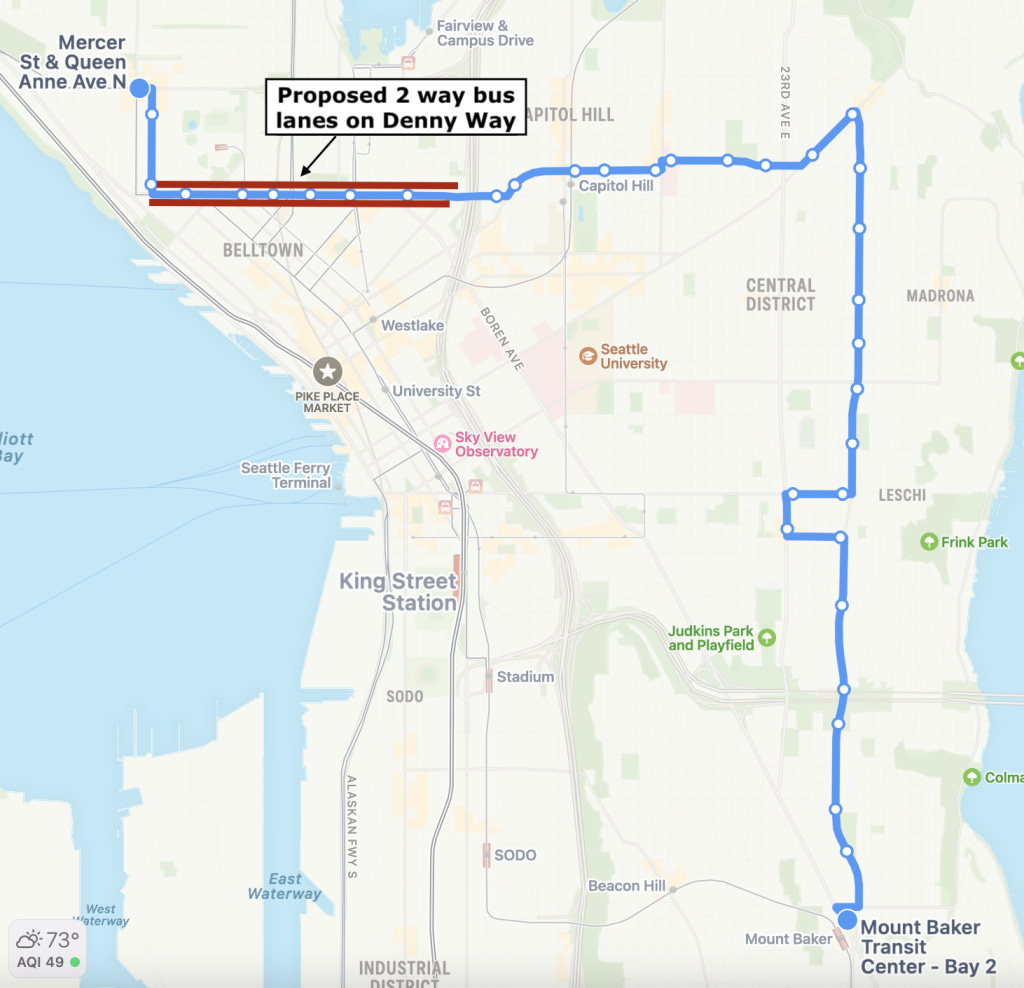
(From the L8 website, when this fix was just a twinkle in progressives’ eyes).
The 8 carries about 7,000 people a day and was the least reliable route in King County, — hitting only 31% eastbound on-time at rush hour last July against a goal of 80%. It is so slow that last summer 200 people raced it down Denny, hopscotching and polka dancing and the like. The people on foot won, which means commuters under Bruce Harrell lost.
It wasn’t even close. The bus averaged 1.4 miles per hour.
Five weeks later, Harrell’s SDOT ruled out a fairly easy fix — a protected bus lane for a small stretch, because it would inconvenience car drivers who already get almost all the right-of-way in the entire city. SDOT’s sophomoric analysis also pretty much ignored how much demand for driving varies when conditions change.
Then Wilson won, replaced the SDOT director, and signed an executive order on January 15th telling them to build it anyway.
She and Councilmember Rinck also jumped into help with painting.
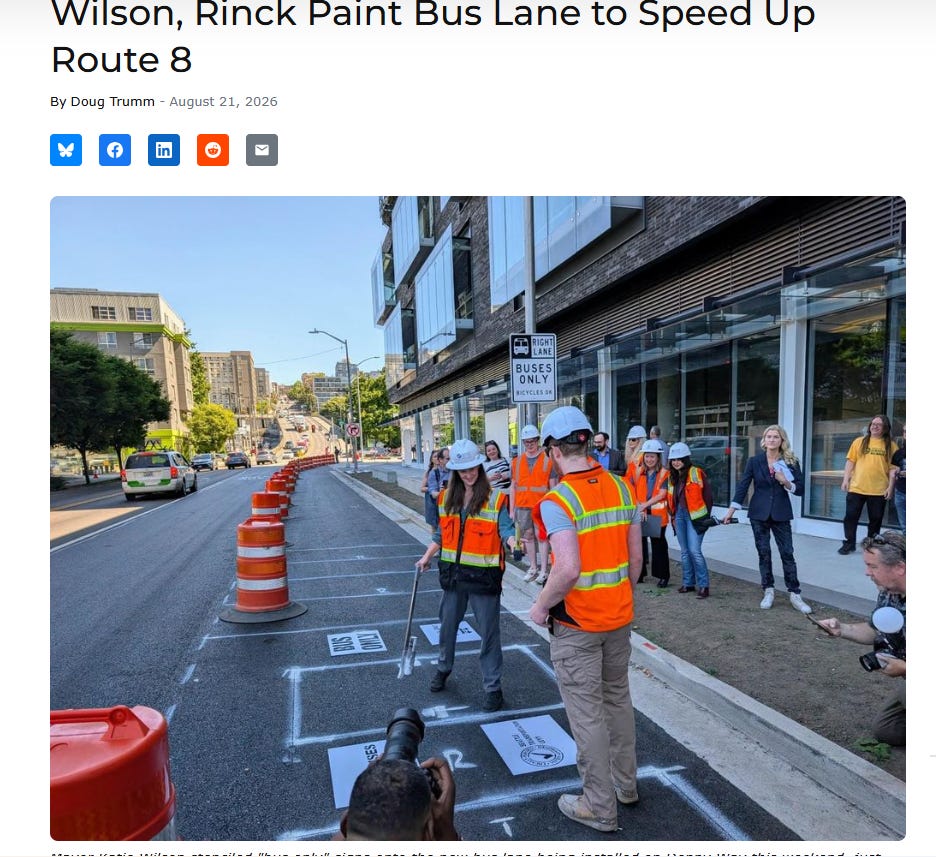
Photo credit, the Urbanist.
The lanes opened August 25th.
The video shows how drastically the bus has sped up.
Eight months and four million dollars from executive order to red paint.
For comparison, we spent roughly $100 million on a police hiring push that netted approximately zero additional officers.
And for the drivers? Alex Hudson, a senior policy advisor in Wilson’s office, pointed out to MyNorthwest that travel times for riders and drivers counter-intuitively often go down when you paint a bus lane. This is likely in part to the change in demand for driving on that road at that time. Time will tell, (and so will SDOT, because the Mayor is requiring it!) but this is the norm.
It doesn’t look anything like the traffic-pocalypse that the planners claimed when they ignored the reams of past data and instead predicted the future with their vibes.
And this is a pattern.
Business leaders screamed that the minimum wage was going to kill restaurants. Sick leave was going to break small business. JumpStart was going to slaughter the golden goose — it hit $383 million last year. The social housing tax was going to go nowhere and kill businesses. It was projected at $50 million and brought in $115 million. And most Seattle high paying job categories are growing faster than Bellevue, which doesn’t have these taxes.
And now 7000 people a day get a shorter commute.
A bus lane is not a giveaway. It’s a smart use of resources.
A general traffic lane moves somewhere between 600 and 1,600 people an hour. That’s NACTO’s number, and it assumes 600 to 800 cars an hour with one or two people in each.
A dedicated bus lane moves up to 8,000.
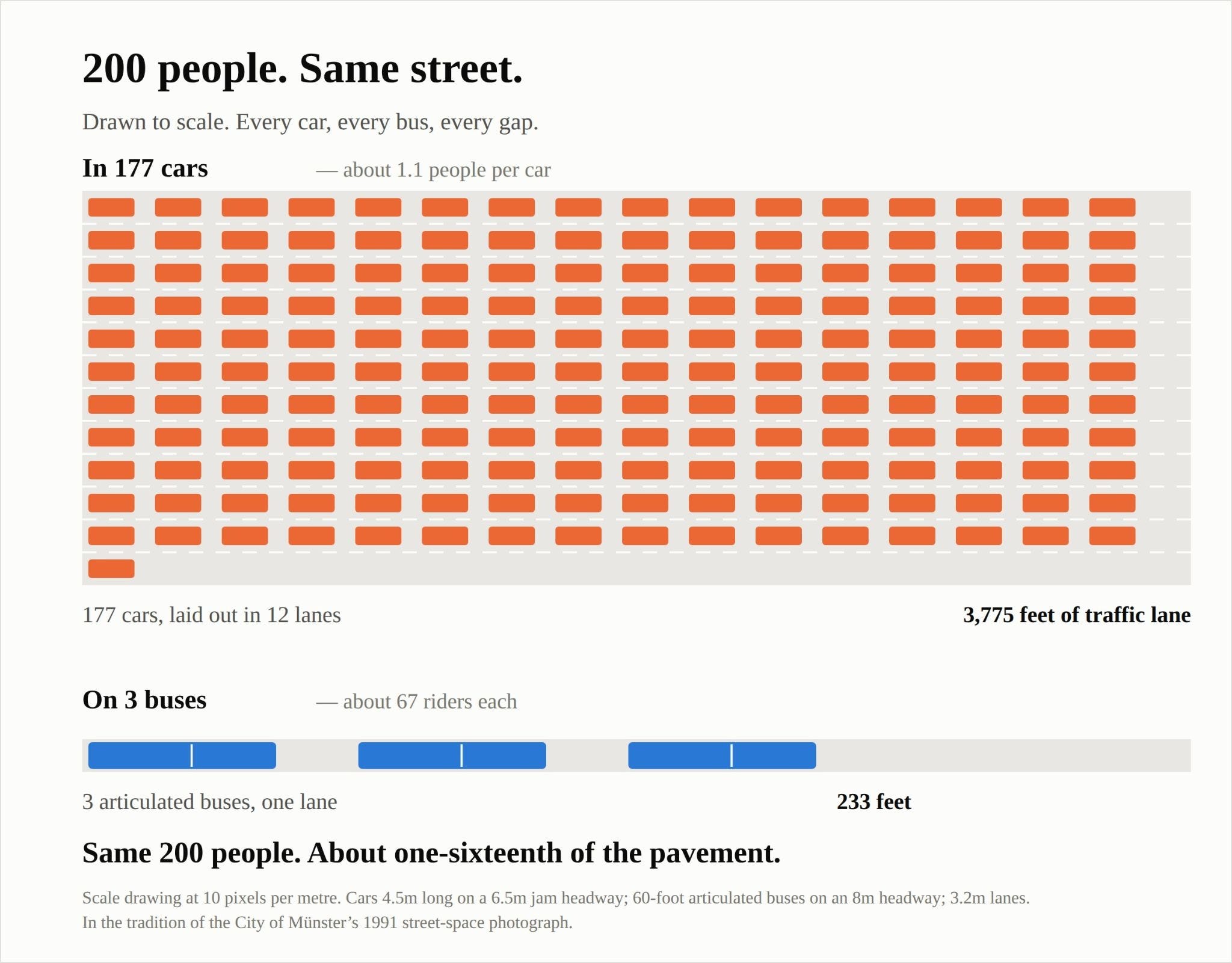
(I generated this image with AI because I can’t draw worth sh**).
Paint the lane red and it didn’t get smaller. It got several times better at its actual job.
SDOT is now looking at nine more corridors thanks to Mayor Wilson!
That’s the model, and it isn’t complicated: a mayor who rides the bus, listens to people who ride the bus, doing a cheap unglamorous thing fast — over the objection of a traffic study that valued vibes and not data about drivers’ convenience over the actual time of seven thousand riders, most of whom aren’t rich and none of whom hired a lobbyist.
More red paint. Nine more corridors. Let’s go!